Luscombe Lab · OIST

Genomics and Regulatory Systems Unit

Gene regulation, genome evolution and population genomics of a globally distributed marine plankton.

Our research Join us

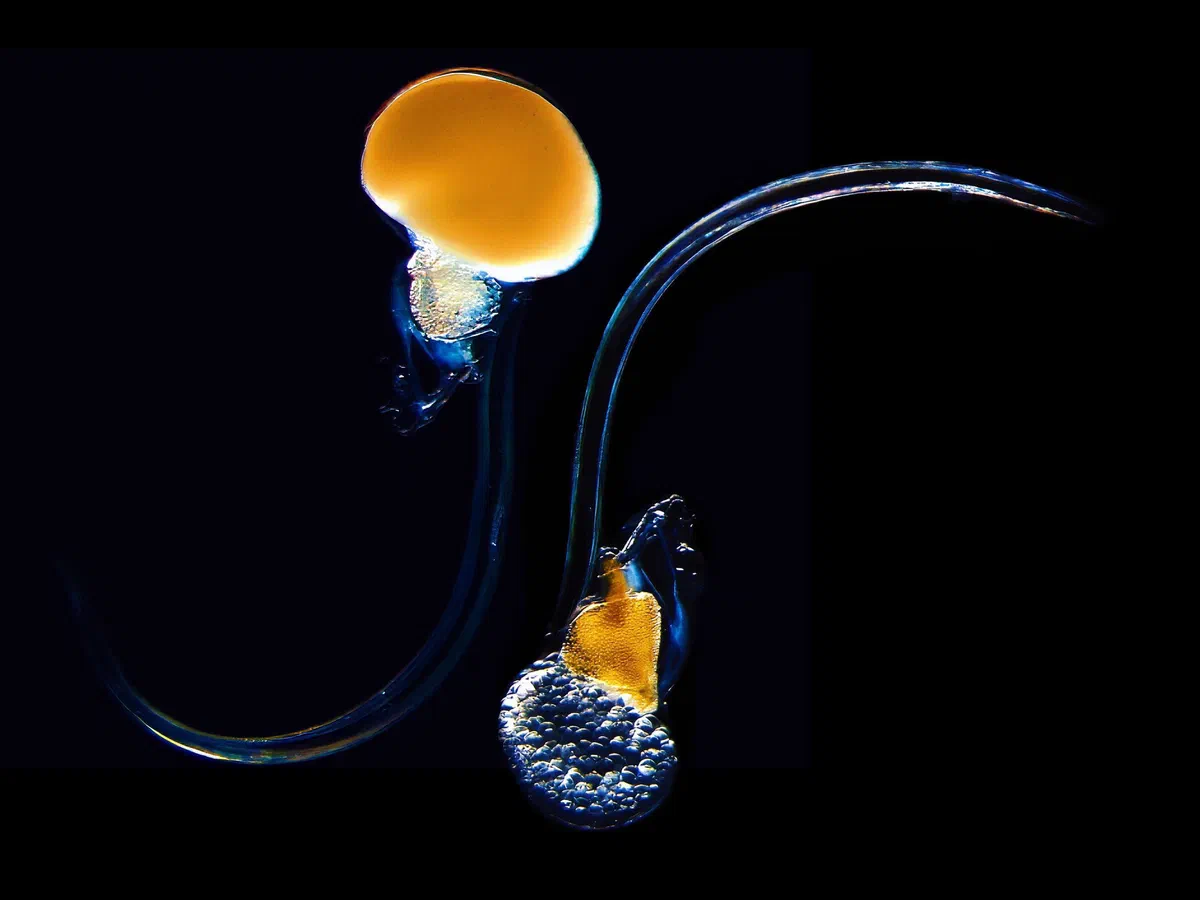
Male and female Oikopleura dioica

To function normally, organisms must ensure that genes are switched on and off at the right times and locations. Gene expression control is a complex process that requires the coordinated action of many regulatory biological molecules. Defects in the process can lead to many diseases, such as cancer. The Genomics and Regulatory Systems Unit combines computational and experimental methods to study principles of gene regulation during early organismal development, using Oikopleura dioica as a model organism.

We wish to understand the population, life cycle, and gene regulatory mechanisms of zooplankton in marine ecosystems using the globally distributed larvacean Oikopleura dioica. We achieve this by studying oceanic specimens and in-house animal cultures. Specifically, we will answer the following questions:

  1. What is the population structure of larvaceans across the world’s oceans and how do they evolve?
  2. In what ways do the genomes of larvaceans affect their developmental, morphological and behavioural characteristics?
  3. What is the interplay between the population genomic and phenotypic properties of larvaceans with the marine ecosystem?

Our unit applies computational and statistical methods to analyse genome-scale measurements. By taking a genomic perspective, we uncover global principles that encompass many biological conditions. We apply this knowledge to understand features unique to individual systems or organisms within a broader context. Ultimately, we wish to achieve quantitative explanations to the questions above in order to identify specific biological interventions that can help maintain or rebuild healthy marine ecosystems.

Meet Oikopleura dioica in the plankton gallery

See our science in action

Plankton gallery
Tiny Titans – Part 1
HORIE ONE × OIST (from 7:24)

Research topics

01

Comparative genetic analysis of Oikopleura dioica

Our analysis has shown that morphologically identical populations of O. dioica spread across the globe show notable genomic differences, suggesting cryptic speciation. These differences even include gene order that is typically conserved across chordates. This unprecedented genomic flexibility highlights the species as a prime model for investigating the dynamics of gene order evolution and synteny conservation, offering insights into the balance between genomic structure and phenotypic stability.

Plessy and Mansfield et al., Extreme genome scrambling in marine planktonic Oikopleura dioica cryptic species. Genome Res. 2024.

02

Population genomics and pangenomics of Oikopleura dioica

What is the population structure of larvaceans across the world’s oceans and how do they evolve? While we have shown significant genetic diversity among populations spanning large geographic distances, limited information exists regarding the structure and genetic diversity in local populations. We focus on addressing this gap by examining genotypes of the populations around the Ryukyu Islands, spanning from Kume to Amami. In parallel, we are assembling multiple genomes into an O. dioica pangenome to capture the full range of genomic variation, including large structural rearrangements, within and between populations.

03

Marine climate change adaptation

Oikopleura dioica is a globally ubiquitous plankton. How do they adapt to exceptionally diverse marine environments? By performing stress experiments (change in temperature, pH, salinity), and employing genomic and epigenomic sequencing techniques, we aim to elucidate the gene regulation mechanisms that enable them to thrive in different water conditions.

04

Functional genomics of Oikopleura dioica

It is unknown how geographically different populations with identical morphology but strikingly distinct genomes maintain their gene expression. Using advanced sequencing techniques to sequence epigenetic modifications and transcriptional patterns, we aim to uncover the mechanisms of gene regulation that make up for these differences in the genome structure.

05

A new de novo genome assembly algorithm

We are developing a novel targeted assembly algorithm that excels in creating haplotype-resolved assemblies with exceptional accuracy, initially for short, simple human genomic regions but now also for a complete Oikopleura dioica genome. This method outperforms current methods by not needing trio binning or Hi-C data, aiming for broader application in small genome assembly. The goal is to assemble multiple Oikopleura genomes to explore genetic diversity within the species.

Dierckxsens et al., Unlocking the full potential of Oxford Nanopore reads with NOVOLoci. bioRxiv 2025.

Latest publications

All publications
  1. nf-core/pairgenomealign: a scalable pipeline for pairwise whole-genome alignment

    C Plessy, M Mahdi, T Fujita, MC Frith, NM Luscombe

    bioRxiv, 2026 Preprint

  2. Pathogenic Keratinocyte States and Fibroblast Niches Define the Tissue Microenvironment in Severe Hidradenitis Suppurativa

    X Du-Harpur, C Gânier, P Mazin, C Cheshire, J Gabriel, E Rashidghamat, NM Luscombe, M Lynch, FM Watt

    Journal of Investigative Dermatology, 2026

  3. nf-core/cutandrun: A Nextflow pipeline for the analysis of CUT&RUN, CUT&Tag and TIP-seq datasets

    TL Hodgetts, C West, NM Luscombe, J Ule, J Briscoe, C Cheshire

    The Journal of Open Source Software 11(119):9672-9672, 2026

  4. Transforming Life Science Through Chromosome-Level Genome Assemblies

    T Kon, K Kataoka, YJ Luo, JN Wibisana, K Toga, N Uno, Y Monden, M Hamada

    Genes to Cells 31:e70145, 2026 Review

Interested in joining us?

We welcome students, interns and postdocs from biology, computation and beyond.

Open positions